Tribal Life and Culture of Odisha
1. Description of the Artwork
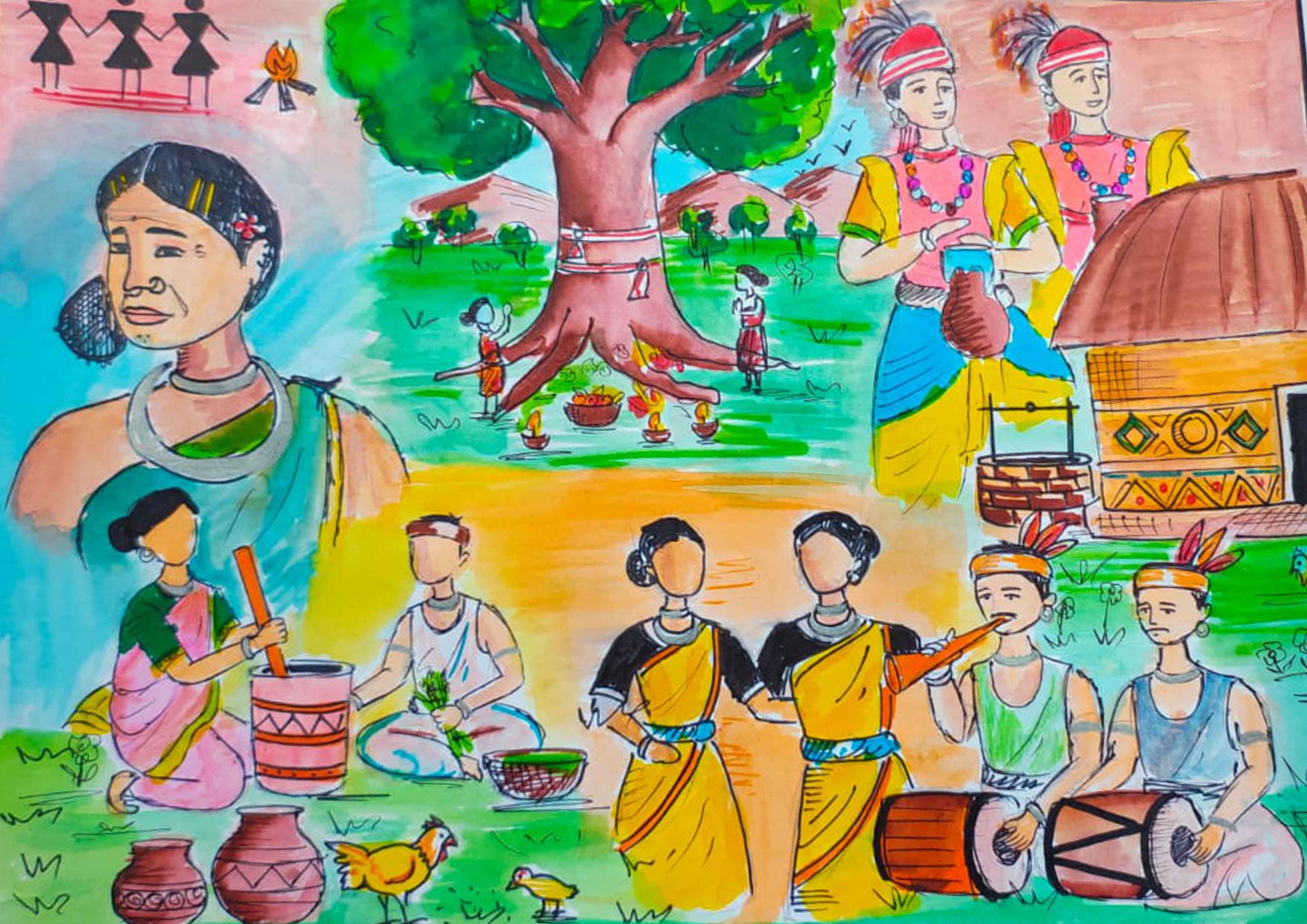
This vibrant artwork portrays the multifaceted socio-cultural tapestry, spiritual traditions, and daily life of the indigenous tribal communities of Odisha. Rooted in an enduring harmony with nature, the composition captures various scenes woven together into a narrative landscape:
- Sacred Nature and Worship (Top Center): At the heart of the village stands a venerable sacred tree (Jahar, Sal, or Banyan tree), sanctified with sacred cloth, clay lamps (diyas), and offerings. Community members gather around in quiet devotion, reflecting the animistic reverence for natural spirits, deities, and sacred groves (Jahirayo or Sarna).
- Music and Communal Dance (Foreground and Right): Celebrations are brought to life by tribal youth dressed in traditional attire—draped dhotis, bright turbans adorned with feathers, traditional jewellery, and brass ornaments. Performers play classical folk instruments such as the indigenous wooden horn or trumpet (Mohuri or Bansuri) and rhythm-keeping drums (Madal or Dholak), accompanied by women dancing arm-in-arm.
- Everyday Village Life and Sustenance (Bottom Left): Depicts traditional domestic chores and pastoral living, including women pounding grains using a wooden pestle and mortar (Dheki or Kundi), preparing herbs, earthen pots (Handi) for cooking and water storage, and domestic livestock (hens and chicks) roaming freely.
- Traditional Architecture and Well (Mid Right): Shows a thatched mud hut (Chhala or Ghar) decorated with geometric and floral tribal wall motifs (akin to Saura or Santhal wall art) alongside a brick or stone village well used for daily water collection.
- Matriarch or Tribal Elder (Mid-Left Portrait): A prominent portrait of an elder tribal woman wearing distinctive heavy metallic neck rings (Khagla or Hansuli), nose rings, hairpins, and draped saree, symbolizing wisdom, heritage preservation, and matriarchal strength.
- Pictographic Folk Art (Top Left): Traditional silhouette dancing figures painted around a campfire, echoing ancient rock art and the stylized stick-figure iconography of eastern Indian tribal paintings.
2. Materials Used
- Surface: Cartridge paper or heavyweight drawing sheet (approx. 180 to 220 GSM) to provide a sturdy base suitable for both wet and dry coloring media without warping easily.
- Drafting Tools: HB or 2B graphite pencils, eraser, and a 30 cm ruler for sketching proportions, page borders, and layout placement.
- Inking and Outlines: Black fine-liner pens (0.3 mm and 0.5 mm) and waterproof marker pens for crisp contouring that will not bleed when colored.
- Coloring Media: Watercolors, poster colors, gouache, brush pens, and colored pencils. Watercolor washes for background landscapes, sky, and foliage; brush pens and colored pencils for details, fabric patterns, and ornaments.
- Brushes and Accessories: Round synthetic brushes (Sizes 2, 4, and 8), a flat wash brush (Size 10), water container, mixing palette, and tissue paper for blending.
3. Step-by-Step Drawing and Painting Process
Step 1: Layout and Border Framing
- Mark a clean border around the perimeter of the drawing sheet using a pencil and ruler.
- Divide the composition into distinct zones:
- Upper central area for the sacred tree and hills.
- Lower foreground for dancers, musicians, and village activities.
- Left flank for the elder woman portrait.
- Right side for the traditional hut and well.
Step 2: Preliminary Pencil Sketching
- Lightly sketch the central tree with spreading branches, leafy canopies, and undulating background hills.
- Outline the elder woman profile with placement of hair buns, head ornaments, and heavy neckpieces.
- Draw the figures in rhythmic postures:
- Musicians holding the Madal drums and horn.
- Dancing figures with interlocking arms.
- Women grinding grains near earthen pots and poultry.
- Add structural elements such as the thatched hut adorned with tribal geometric wall patterns.
Step 3: Inking and Detail Definition
- Using a fine-line waterproof black pen (0.3 to 0.5 mm), trace over the pencil lines to finalize contours.
- Add ethnic tribal stick figures in the top-left corner representing ancestral fire-side celebrations.
- Ink decorative details like necklaces, feathers, cloth folds, and bark textures.
- Allow the ink to dry completely and gently erase excess graphite pencil marks with a soft eraser.
Step 4: Background and Base Washes (Underpainting)
- Apply transparent wet-on-dry watercolor washes:
- Sky and Mist: Pale cerulean blue fading toward soft peach or light yellow near the ground.
- Ground: Warm ochre, light sandy yellow, and soft grassy green washes to define village pathways and meadows.
- Foliage: Sap green and viridian washes for tree crowns and distant hillocks.
Step 5: Layering and Figurative Coloring
- Skin Tones: Mix burnt sienna, yellow ochre, and warm white to paint natural skin tones.
- Attire and Drapery: Fill sarees, dhotis, and headbands with vibrant pigments—cadmium yellow, cobalt blue, crimson red, and leaf green.
- Architecture and Accessories: Paint the tree trunk, thatched roof, and earthen pots using burnt umber, raw sienna, and terracotta brown.
Step 6: Texturing, Shading, and Highlights
- Use colored pencils and fine brushwork to add shadow depth to garment folds and the tree bark.
- Accentuate ornaments, jewelry, and wall motifs using crisp black linework or gouache touches.
- Refine the outer border lines with an even black stroke to create a neatly framed presentation.